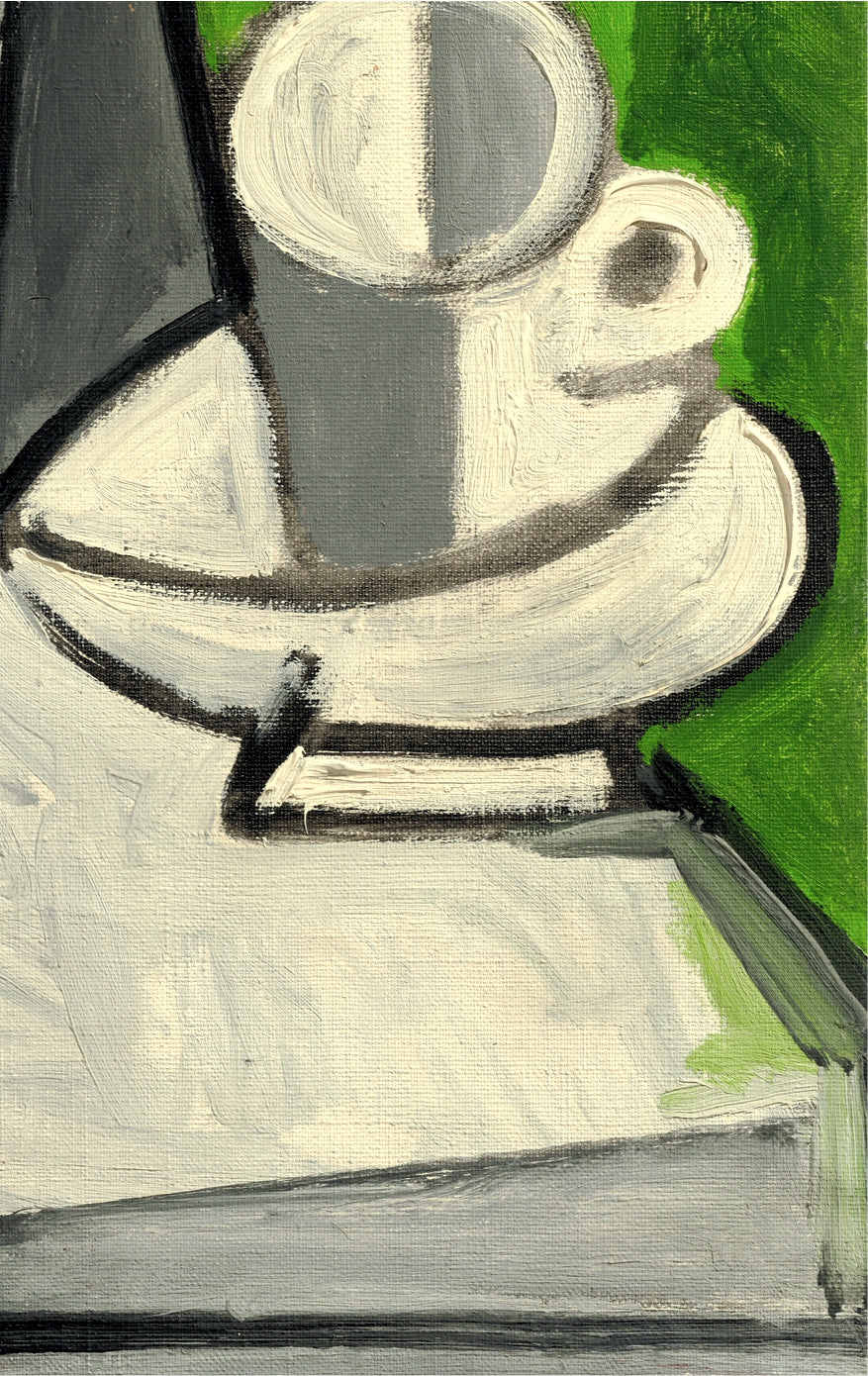
This striking still life painting, Still Life with Coffee Pot, reflects the bold visual language developed by Pablo Picasso during the later phases of his exploration of Cubism. The composition presents a carefully arranged group of everyday objects—a coffee pot, lamp, cup and saucer—transformed into a dynamic arrangement of geometric forms and contrasting colors.
At the center of the painting stands a tall, angular coffee pot rendered in simplified planes of white, gray, and black. Its triangular and vertical shapes create a sense of architectural solidity, almost resembling a small abstract structure rather than a domestic object. The bold black outlines emphasize the fractured geometry typical of Cubist composition, allowing the viewer to perceive multiple perspectives simultaneously.
To the left of the coffee pot appears a bright yellow oil lamp, its curved base and cylindrical glass chimney contrasting with the sharper angles of the central object. The lamp introduces a strong chromatic accent that energizes the composition. On the right side of the table rests a small white coffee cup placed on a saucer, painted with soft circular forms that balance the vertical dominance of the central elements. These rounded shapes provide visual relief and reinforce the still-life theme of simple domestic objects.
The background is dominated by a vivid green field that envelops the scene, creating a dramatic contrast with the muted tones of the objects. This monochromatic backdrop isolates the still-life arrangement and heightens the visual impact of the composition. Picasso’s brushwork remains expressive and direct, with visible strokes that give the painting an immediate, almost spontaneous character.
Despite its abstraction, the painting preserves the recognizable identity of each object. Picasso achieves a delicate balance between representation and abstraction, transforming familiar household items into sculptural forms within a carefully structured composition.
Overall, the work exemplifies Picasso’s ability to reinterpret everyday subjects through modern artistic language, creating a still life that is both playful and intellectually engaging while demonstrating the enduring vitality of Cubist experimentation.