Couldn't load pickup availability
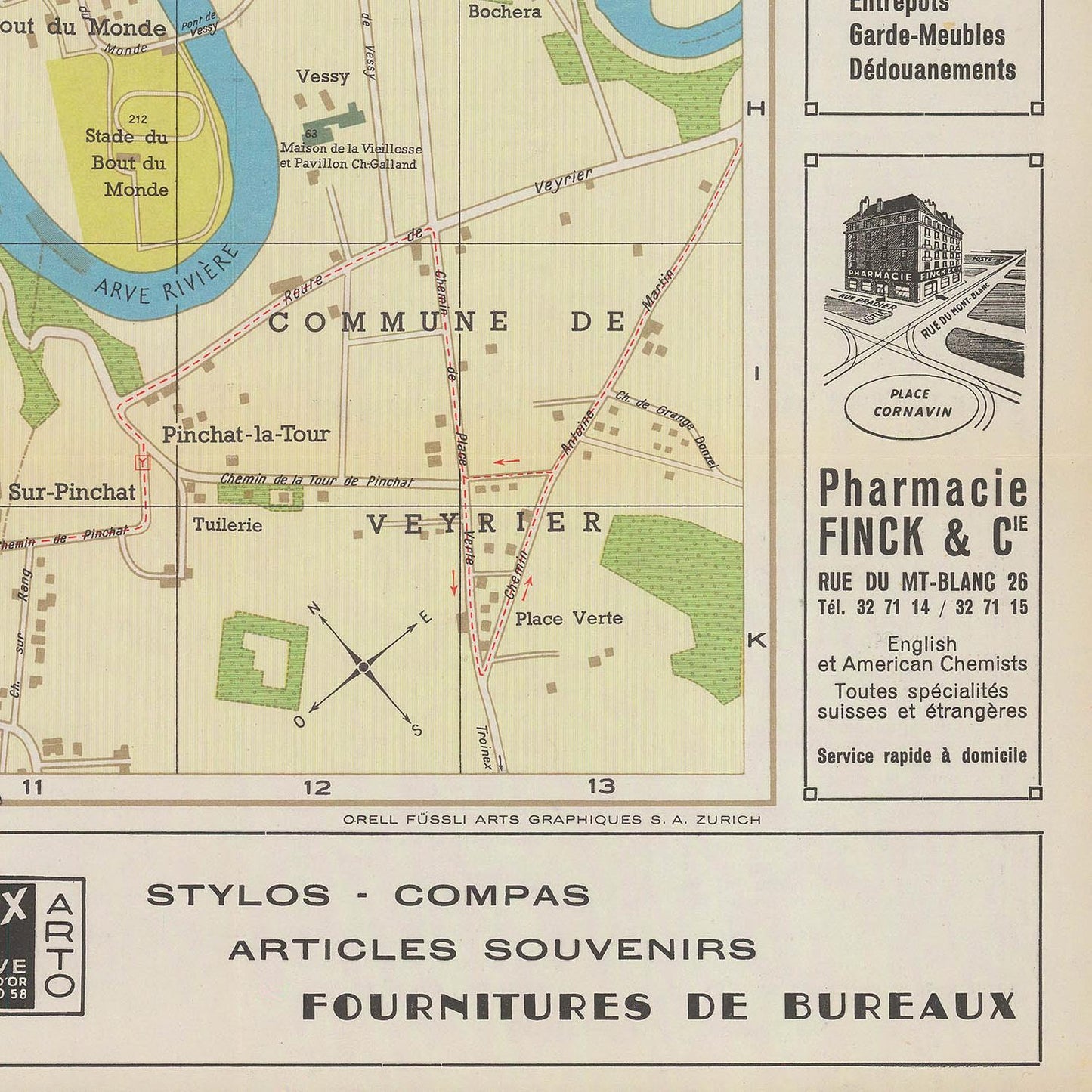
In 1957, Geneva stood at the intersection of tradition and modernity, embodying its long-established role as an international city while adapting to the political and economic realities of the postwar world. Situated at the western tip of Lake Geneva, where the Rhône flows out toward France, the city presented a carefully ordered urban landscape framed by water, mountains, and an expanding metropolitan fabric. The Jet d’Eau, already a defining landmark, symbolized both technical confidence and civic identity, rising prominently against the backdrop of the Alps and the Jura.
The historic core—centered on the Old Town (Vieille Ville) and St. Pierre Cathedral—retained its dense medieval street pattern, contrasting with the more rational urban planning of the 19th and early 20th centuries visible in districts such as Plainpalais and Eaux-Vives. By the late 1950s, new residential blocks, transportation infrastructure, and administrative buildings reflected Geneva’s growing population and its increasing international responsibilities.
Geneva in 1957 was firmly established as a hub of diplomacy and humanitarian governance. The presence of the United Nations Office at the Palais des Nations, along with organizations such as the International Committee of the Red Cross and numerous specialized agencies, shaped both the city’s economy and its cosmopolitan character. This international dimension influenced urban development, cultural life, and architecture, introducing a modernist vocabulary alongside traditional Swiss restraint.
Economically, the city balanced finance, precision industries, and international services, while maintaining a reputation for stability and neutrality during the Cold War era. Public spaces, lakeside promenades, and carefully managed vistas underscored Geneva’s emphasis on quality of life and civic order.
Viewed in retrospect, Geneva in 1957 represents a moment of confident transition: a historic city consolidating its global role while preserving the spatial and cultural continuity that had defined it for centuries.
Materials
Materials
Cotton canvas, matte photo paper, fine art paper, pigmented inks.
- The canvas it's 99 % cotton, 450 gr/sqm;
- The matte photo paper it's acid-free (archival paper), 190 gr/sqm;
- The fine art photo paper it's satinated (semi-glossy), 140 gr/sqm.
Shipping & Returns
Shipping & Returns
Dispatching time: 1-2 days.
* Standard shipping fee: The orders will be sent by priority registered mail, usually via client National Post (USPS, Canada Post, Royal Mail, LaPoste, Deutsche Post, PostNL, etc). The delivery times are not guaranteed, sometimes it will take longer and these are beyond our control. Tracking number will be provided. Clients from US and Canada cannot track the parcels as the tracking numbers are not rolled in USPS and Canada Post systems.
* UPS standard: The orders will be sent with UPS expedited option. The delivery time it's between 5-11 days. Tracking number will be provided after dispatch.
* UPS express: The orders will be sent with UPS express saver. The delivery time it's between 4-7 days. Tracking number will be provided after dispatch.
Framing tips
Framing tips
Both type of materials, paper and canvas prints come rolled and will be need to be taken to your local framers.
The image it's printed with a border of 0.6 " (1.5 cm), for framing purposes only.
If you have already a frame, be sure you send us the exact size of the print that will fit inside the frame. We're printing on vectorial plotters so the size could slightly be more or less with 0.4" (1 cm).
If you plan to have the canvas print stretched on wooden frame, you'll need additional border, so please let us know after placing the order.
The images above was cropped from the image at the biggest size available (keeping the best quality and aspect /ratio), so, for good details please choose biggest dimensions that will suit your preferences / space.
Care Instructions
Care Instructions
The print media (canvas or photo paper) could be cleaned only with a dry, soft cloth.
Share

Wine maps
Explore the rich history of wine through centuries-old maps. Dive into the heritage, culture, and geography of wine regions with our collection of vintage wine maps.
These meticulously preserved historical treasures offer a window into the evolution of viticulture, showcasing how wine regions have transformed over the centuries.
-
Gastronomic maps
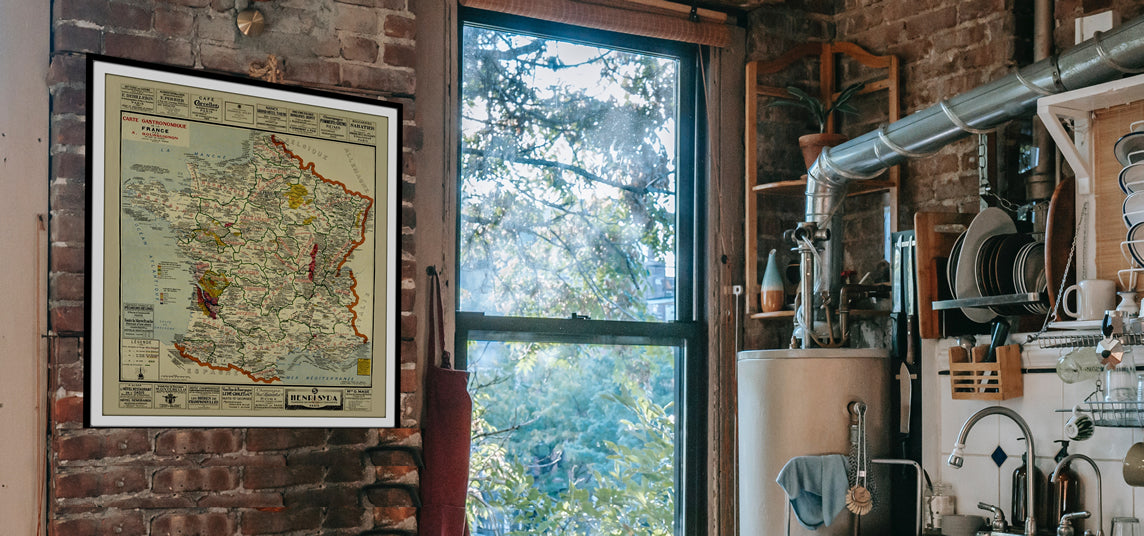
Dive into a world of culinary exploration with our collection of gastronomic maps – your passport to gastronomic adventures like no other. Discover the intricate art of cheese-making and the exquisite world of gourmet delights through our meticulously curated Cheese Maps and Gastronomic Maps.
-
Empires maps
Travel through history as you explore the territorial expanse, conquests, and cultural influences of some of the world's most powerful civilizations. Our antique maps bring the epic tales of empires to life, offering a captivating glimpse into the rise and fall of these extraordinary realms. See all empires maps >